
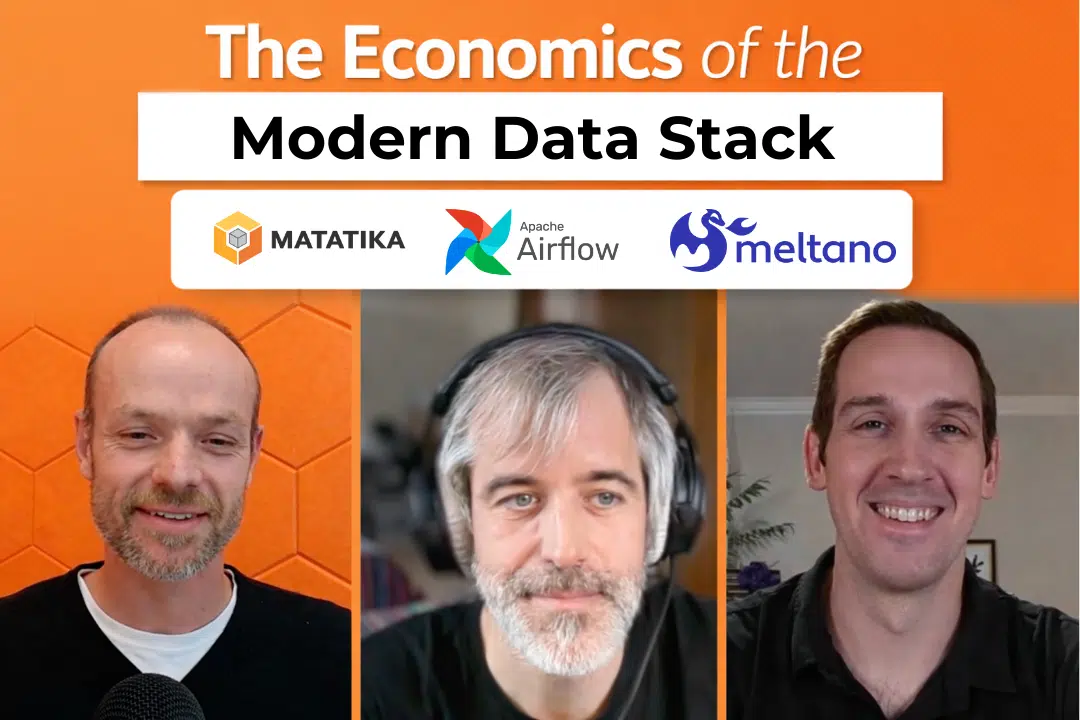
The Economics of the Modern Data Stack
How we got here: from three vendors to twelve categories
Max framed the origin of the modern data stack as a necessary correction. Historically, most teams operated with a small number of tightly coupled layers. The move to the cloud exposed how poorly incumbents adapted to that shift and opened the door for SaaS-first, cloud-native tools that were faster, more flexible, and more aligned with how teams wanted to work.
“We didn’t move from three layers to twelve because teams asked for complexity. We moved because incumbents were stuck, and venture capital funded a category explosion.”
That explosion created real progress. Infrastructure-as-code, configuration-as-code, and modular architectures gave teams a sense of sovereignty they had not experienced before. For a period of time, assembling a modern stack felt empowering rather than burdensome.
Taylor reinforced that this promise was genuine. In the late 2010s, a stack built around Snowflake, dbt Core, and a small set of ingestion tools could work exceptionally well when teams were disciplined about ownership and cost. Self-serve analytics became achievable in practice, not just in theory.
What shifted was not capability, but scale. As organisations added more tools to address increasingly specific needs, the operational and economic overhead of running the stack began to grow faster than the value it delivered. The stack did not break, but it quietly became harder to manage.
The “ball of duct tape” problem: why sprawl is hard to reverse
One of the most resonant ideas in the session was the metaphor of the stack as a ball of duct tape. Over time, tools that begin as experiments become dependencies, and dependencies harden into architecture. Once that happens, removing a tool no longer feels like a preference decision. It feels like a migration programme.
“Most data stacks eventually become a ball of duct tape. Once everything is connected, removing anything feels dangerous.”
This explains why sprawl is so difficult to reverse, even for strong teams. Refactoring a live stack carries real risk, requires coordination across functions, and rarely aligns with short-term business incentives. The result is that many organisations choose stability over optimisation, even when costs rise or satisfaction declines.
That dynamic also explains vendor pricing power. When the burden of change sits entirely with the buyer, vendors are insulated from churn. Renewals become easier to justify than rewiring core infrastructure, regardless of whether pricing still feels proportional to value.
Managed open source: the playbook, the tradeoffs, and the limits
The conversation then turned to managed open source, using Airflow and Astronomer as a familiar example. The model is straightforward in theory: keep the core engine open, and commercialise the operational complexity around it.
Max offered a clear economic framing for why this works and where it breaks.
“Open source creates enormous value, but no company can capture all of it. You have to decide whether you’re growing the pie or trying to take a bigger slice.”
That decision carries consequences. When monetisation pressure increases too quickly, communities notice. Packaging changes, licensing decisions, and shifts in product focus all signal how value is being redistributed. Open source projects can continue to thrive on adoption while still struggling to support aggressive commercial expectations.
Taylor illustrated this tension from the buyer’s perspective. dbt Core delivered substantial value without direct payment, which accelerated adoption but also widened the gap between value created and value captured. Over time, that gap becomes difficult to ignore. Not because the product stops working, but because the economics demand resolution.
dbt + Fivetran: what the merger signals (and why it matters)
Against that backdrop, the dbt and Fivetran merger emerged as a signal rather than a shock. The panel was less interested in immediate product changes and more focused on what consolidation says about the direction of the market.
Taylor described one possible motivation as a way to anchor transformation tooling more firmly within a platform narrative, even if the products themselves remain loosely coupled. Max added that acquisitions can also strengthen negotiation leverage by expanding a vendor’s gravitational pull within the stack.
From an operator’s standpoint, the practical takeaway is simple. Mergers change incentives, and incentives shape behaviour. Even if nothing breaks in the short term, packaging, pricing, and roadmap decisions are unlikely to remain static. For teams making long-term architectural bets, that shift deserves attention.
Ingestion economics: commodity in theory, sticky in reality
Ingestion became a focal point because it is often where budget pressure surfaces first. On paper, ingestion appears commoditised. The output is data in the warehouse. In practice, pricing rarely reflects that simplicity.
Taylor explained that the economics depend heavily on context. When being late by an hour is tolerable, ingestion feels interchangeable. When ingestion is business-critical, pricing reflects the cost of failure rather than the mechanics of extraction.
Max added that ingestion carries structural stickiness. Supporting a long tail of SaaS APIs, handling edge cases, and maintaining reliability at scale creates defensibility. Even when prices rise, the friction involved in migrating pipelines often outweighs the immediate savings, reinforcing vendor leverage.
This is where the duct tape metaphor and pricing power converge. The more embedded ingestion becomes, the less it behaves like a commodity, regardless of how similar the outputs look.
Why migrations are priced the way they are
Migrations sat underneath many of these themes as the unspoken constraint. Max captured it bluntly.
“No one wants to own a rip-and-replace migration.”
Migrations are risky, time-consuming, and rarely celebrated internally. They pull teams away from business-facing work and demand careful coordination across systems that have evolved over years. Even when vendors offer migration support, the organisational cost remains significant.
From an operator’s perspective, this has real consequences. When migrations are perceived as exceptional events rather than solved problems, the burden of change remains with the buyer. That burden shapes renewal decisions, weakens negotiation leverage, and allows pricing pressure to compound over time.
The result is not vendor lock-in by design, but lock-in by inertia.
AI and what comes next: can it untangle the stack?
The session closed by looking forward. Max described how AI, particularly emerging MCP-style approaches, could change how teams interact with complex stacks.
Rather than focusing on code generation alone, the promise lies in AI’s ability to traverse repositories, pipelines, and tool interfaces to surface understanding across the system. If AI can help teams reason about dependencies, lineage, and operational state, it may reduce the cognitive and operational cost of managing sprawl.
As Aaron summarised during the discussion, if AI can genuinely help untangle the duct tape, it changes the economics of operating the modern data stack. That shift is still early, but it represents one of the few credible paths toward regaining leverage without rebuilding everything from scratch.
Watch the full discussion
This blog captures the structure of the conversation, but the nuance lives in the discussion itself. The back-and-forth between Max, Taylor, and Aaron adds context, examples, and depth that are difficult to fully convey in writing.
If you are making decisions about your data stack, vendor relationships, or long-term architecture, the full session is well worth watching.
👉 Watch the full LinkedIn Live on YouTube:
https://youtu.be/Ie2DMsRvwow
The economics of the modern data stack are no longer abstract. They are shaping real decisions today.